Key Takeaways:
-
The "Hardscape" Risk: Unlike living rooms where you can move furniture, bathroom mistakes involve permanent tiles and plumbing. AI visualization is your insurance policy. Using an AI powered tool to upload a bathroom photo is the first step-this enables realistic, customized virtual renovations tailored to your space.
-
Lighting is Key: AI transforms the way lighting and materials are visualized, helping you see how backlit mirrors interact with dark vs. light wall textures-critical for grooming and ambiance. This process helps save money by preventing costly mistakes during your bathroom remodel.
-
Space Hacking: For compact UK bathrooms, AI tools can run dozens of layout scenarios (Shower vs. Tub) in minutes, letting you test unlimited design variations for your bathroom remodel.
-
Material Mixing: AI solves the "sample dilemma," allowing you to see how brassware truly looks against marble before you buy, including color coordination and experimenting with different tile colors as part of the material selection process.
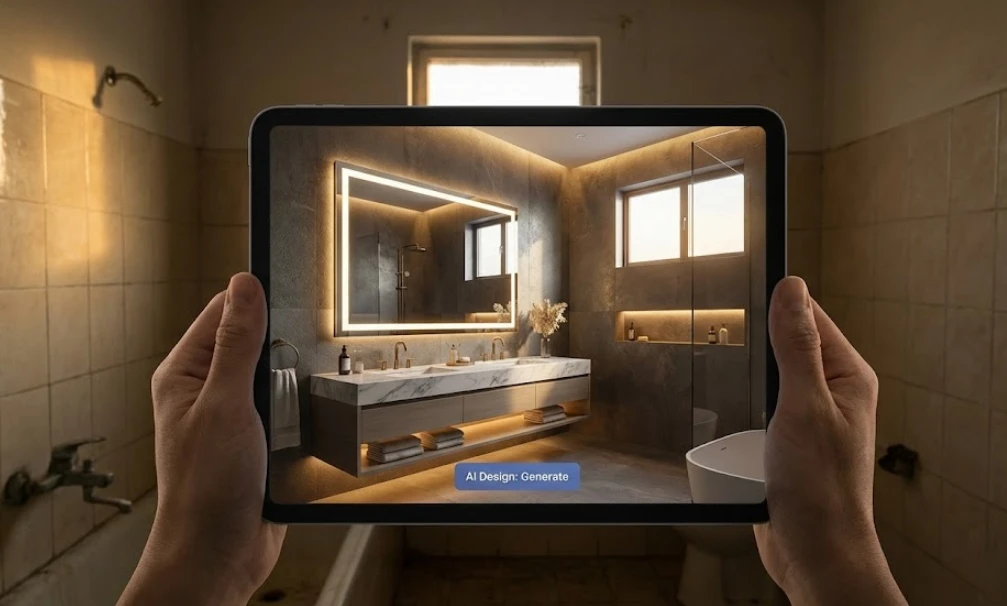
Introduction: The High Stakes of the Smallest Room
Renovating a bathroom is arguably the most stressful home improvement project a homeowner can undertake. It is a game of high stakes and permanent consequences. If you buy a sofa that doesn't quite match the curtains in your lounge, you can return it or simply move it to another room. But if you install 20 square metres of charcoal slate tiles only to realise they make the room look like a dungeon, you are stuck. You cannot simply "move" a bathtub or "return" a grouted wall.
The bathroom is an "unforgiving" room. It relies heavily on "hardscape"-fixed elements like ceramics, stone, glass, and plumbing. Because of this, the gap between imagination and reality is dangerous. We all collect scraps of inspiration: a brass tap from Pinterest, a subway tile from a hotel visit, a backlit mirror from Instagram. But combining these isolated ideas into a cohesive whole is where most DIY designs fail. An ai designed bathroom bridges this gap, allowing you to visualize your unique bathroom style and see how your inspirations come together before making any permanent decisions.
This is where technology has shifted the paradigm. We are moving away from manual mood boards towards hyper-realistic visualization. By utilising AI bathroom design tools, homeowners can now "rehearse" their renovation digitally. These tools allow you to strip your current bathroom back to the studs virtually, input your room dimensions, and test infinite design options of light, texture, and layout-including showers and fixtures-without creating a speck of dust.
In this guide, we will move beyond simple app recommendations. We will explore how to use AI to solve specific bathroom challenges-from mastering the tricky art of vanity lighting to maximizing the footprint of a compact British bathroom.
Why Bathroom Visualization is Different (and Harder)
You might ask, "Why do I need a specific approach for a bathroom? Can't I just use any design app?"
The answer lies in the complexity of the surfaces. Living rooms are filled with soft, light-absorbing textures (fabric, wood, rugs). Bathrooms, conversely, are boxes of mirrors and hard, reflective surfaces, with hardscape and exposed structural elements forming much of the fixed features.
The Reflection Challenge
A bathroom is a hall of mirrors-literally. Light bounces from the mirror to the glossy tiles, to the chrome taps, and the glass shower screen. Natural light can dramatically change the appearance of reflective surfaces, making a coastal, spa, or tropical bathroom style feel brighter, more open, and relaxing.
-
Traditional Sketching: Cannot capture how light reflects off wet-room glass.
-
Standard AI: Often struggles with mirrors, creating "hallucinations" (weird reflections).
-
Specialised AI Workflows: We need to use tools that understand materiality. You need to see if that high-gloss navy blue tile will reflect the vanity light beautifully or if it will create a harsh glare that blinds you every morning.
The "Permanent" Palette
In a bedroom, the walls are usually painted drywall-easy to change. In a bathroom, the walls are often the product itself (tiles, marble slabs, micro-cement).
-
The Cost of Error: Re-tiling a bathroom during a bathroom remodel costs thousands in labour and materials, making mistakes especially expensive to fix.
-
The AI Advantage: Generative AI allows you to perform a "Material Swap." You can keep the layout exactly the same but command the AI to "change wall tiles to Carrara marble" or "switch to matte black fixtures." This instant A/B testing is the single greatest money-saver in modern renovation.
Analyzing the Tools: A Homeowner's Guide to 2026
Competitors like Craft Kitchen and Bath or Apartment Therapy often list generic tools. However, for a high-end bathroom renovation, you need to understand the nuances of what is currently available. Many AI bathroom design tools offer a free version with basic functionality, while premium plans unlock advanced features such as additional design tools and a broader selection of design elements for more complex projects.
1. Paintit.ai (The Realism Specialist)

While many tools offer cartoonish 3D renders, Paintit.ai focuses on photorealism and "style transfer."
-
Best For: Visualizing how specific materials (e.g., "brushed gold") interact with lighting. It excels at keeping the structural integrity of your room (windows, doors) while completely changing the aesthetic skin. Professional designers can use Paintit.ai to quickly generate and iterate on bathroom concepts for clients, streamlining the design process.
-
The Bathroom Edge: It creates a "flow state" where you can rapidly iterate. You don't get stuck on technical CAD drawing; you focus on the vibe and the finishes.
2. Midjourney (The Concept Artist)

Midjourney is an image generator, not a room planner. It creates stunning, dreamlike images.
-
Best For: Wild inspiration and unlimited design variations. If you want to see what a "steampunk bathroom with copper pipes and a jungle wall" looks like, or explore countless combinations of tiles, vanities, fixtures, and layouts, this is your tool.
-
The Downside: It doesn't respect your room's dimensions. It might generate a bathroom the size of a ballroom when you only have 4 square metres. Use it for mood boards, not blueprints.
3. SketchUp + AI Rendering (The Engineer's Choice)

For those who need millimetre-perfect precision for plumbing layouts.
-
Best For: Contractors and architects, especially those who need to work with precise room dimensions for accurate bathroom planning.
-
The Downside: Massive learning curve. You will spend weeks learning to model a toilet before you even get to choose the colour.
|
Feature
|
Paintit.ai
|
Midjourney
|
Standard CAD
|
|
Learning Curve
|
Low (Intuitive)
|
Medium (Prompting)
|
High (Technical)
|
|
Material Realism
|
High
|
High
|
Varies
|
|
Respects Room Size
|
Yes
|
No
|
Yes
|
|
Lighting Accuracy
|
Good
|
Excellent (Artistic)
|
High (Calculated)
|
The "Hollywood" Factor: Lighting and Mirrors
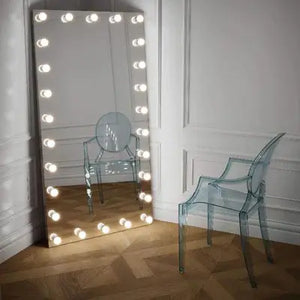
For a site like Hollywood Mirrors, this is the crucial section. Lighting in a bathroom is not just about visibility; it's about how you look and feel. The wrong lighting can cast shadows that make you look tired, while the right lighting creates a luxury hotel vibe. The lighting you choose can also enhance or detract from your chosen bathroom style, whether you're aiming for a modern, traditional, or coastal look.
Visualizing "Colour Temperature"
One of the hardest things to explain to a client is the difference between "Cool White" (4000K) and "Warm White" (2700K).
-
The Problem: Cool light is clinical and great for makeup precision, but it can feel sterile. Warm light is cozy but can distort colours.
-
AI Solution: You can prompt the AI to generate the same room in two lighting scenarios, and also visualize how color coordination is affected by different lighting. This helps you see how various materials and finishes will look together under both warm and cool light, ensuring harmonious color coordination.
-
Prompt A: "Luxury bathroom, white marble, warm ambient evening lighting, 2700K, relaxing atmosphere."
-
Prompt B: "Luxury bathroom, white marble, bright daylight LED task lighting, 4000K, crisp details."
-
Result: You see instantly how the "mood" shifts. You might decide to install a mirror with adjustable colour temperature (a popular feature in modern Hollywood mirrors) after seeing how versatile it makes the space.
The Backlight Effect
Backlit mirrors are trending, but they require a specific wall texture to shine.
-
Smooth vs. Textured: A backlit mirror against a flat white wall looks clean. The same mirror against a split-face stone wall creates dramatic shadows and depth.
-
Simulation: Use AI to test this. Upload a photo of your space and ask the AI to apply "textured slate wall behind vanity with halo lighting effect." You can also test different tile colors behind the vanity to see how they interact with backlit mirrors. This helps you decide if it's worth investing in expensive textured tiles to maximise the impact of your mirror.
Solving the "Tight Squeeze": Layouts for Compact Bathrooms
In the UK, bathrooms are notoriously small. We don't always have the luxury of "double vanities" and "freestanding tubs" seen in American Pinterest boards. Space planning is a game of Tetris, and choosing between different types of showers-such as walk-in showers, tub-shower combos, or wet rooms-can make a significant difference when planning a compact bathroom layout.
The "Tub vs. Shower" Debate
This is the most common dilemma. Should you keep the bath for resale value, or swap it for a luxury walk-in shower?
-
Take a photo of the current bathroom.
-
Use AI to visualize a "Wet Room" concept: seamless floor, glass screen, no tray. This visually expands the floor area.
-
Compare it with a "Freestanding Tub" concept.
-
Insight: AI often reveals that removing the bulky ceramic tub and replacing it with clear glass opens up the visual lines, making a 4m bathroom feel like 6m. These layout decisions are crucial for a successful bathroom remodel, ensuring your new space is both functional and visually appealing.
Verticality and Storage
When you can't build out, build up.
-
Visualizing Storage: Tall, mirrored cabinets can disappear into a room if designed right. Use AI to see if a wall-to-wall mirror cabinet looks sleek or overwhelming.
-
The "Infinity" Trick: Placing a large Hollywood mirror opposite the door or a window creates an infinity effect. Prompt your AI tool to "add large frameless mirror on opposite wall" to see how much "phantom space" it creates.
Material Mixing: The "Texture Swap"
The difference between a "nice" bathroom and a "designer" bathroom is usually in the mix of materials. It is the juxtaposition of cold marble against warm walnut wood, or polished chrome against rough concrete.
The "Metal Clash" Fear
Can you mix a black shower frame with gold taps?
-
Old School Rule: "Match everything."
-
New School: "Curated mixing."
-
AI Verification: It is risky to buy expensive gold hardware just to try it. Use AI to generate the image with "matte black fixtures" and then "brushed brass fixtures."
-
Pro Tip: Look at the reflection in the AI render. Does the gold look gaudy against your chosen beige tile? If so, switch to brushed nickel.
Tile Patterns
Subway tiles are classic, but how you lay them changes everything.
-
Herringbone vs. Stacked: A herringbone pattern adds energy and complexity but is "busier." A vertical stack is modern and heightens the room.
-
The Visualization: Ask the AI to render "white subway tiles, vertical stack pattern" versus "white subway tiles, herringbone pattern." You will instantly feel which one suits your mental state-calm or energetic.
Personalizing Your AI Bathroom Design
Transforming a generic bathroom into a personal sanctuary is effortless with AI bathroom design tools. Instead of guessing how materials will look, you can shape every detail to match your vision:
-
Visualize Instantly: Upload your photo to test layouts, from spa-like retreats with freestanding tubs to efficient powder rooms.
-
Experiment with Style: Swap subway tiles for herringbone or compare brass fixtures against marble in real-time.
-
Tailor to Lifestyle: Use custom prompts to request specific needs, like "family-friendly storage" or "luxury double vanity."
No design experience is needed—just describe your dream space, and the AI helps you refine it until it’s perfect.
Step-by-Step Guide: From Prompt to Plumber
How do you actually do this? Here is a workflow to take you from a vague idea to a plan you can show a builder.
Step 1: The "Audit" Photo
Don't just snap a blurry picture.
-
Clear the decks: Remove shampoos, towels, and the bath mat.
-
Lighting: Turn on all lights.
-
Perspective: Stand in the doorway to get the widest angle. If the room is tiny, take a photo from chest height, not eye height, to capture more of the floor plan.
Step 2: Prompting for Bathrooms (The Secret Sauce)
Bathroom prompting requires specific vocabulary. "Make it nice" won't work. Use these keywords:
-
Styles: Japandi (wood + white), Industrial (black metal + concrete), Biophilic (plants + green tiles), Art Deco (gold + geometric).
-
Fixtures: Floating vanity, wall-mounted taps, rainfall shower head, vessel sink, backlit mirror.
-
Atmosphere: Spa-like, airy, moody, dramatic, sanctuary.
Example Prompt:
"Transform this small bathroom into a modern spa sanctuary. Use large format beige travertine tiles, a floating warm oak vanity unit, and brushed gold wall-mounted taps. Add a large illuminated circular mirror. Soft, warm diffuse lighting. Minimalist style."
Step 3: The Reality Check (The Human Element)
Once the AI generates a stunning image, you must put on your "Project Manager" hat.
-
Plumbing constraints: The AI might move your toilet to the other side of the room. Ask a plumber: "Can the soil pipe actually move there?" If not, prompt the AI again but keep the toilet in the original position.
-
Product Sourcing: The AI might invent a vanity unit that doesn't exist. Use the image as a reference to find "lookalikes" on sites like Hollywood Mirrors or local suppliers.
The Financial Argument: ROI of Virtual Planning
We often hear that "hiring a designer is expensive." AI gives you 80% of the designer's visualization power for a fraction of the cost.
Avoiding the "Return Tax"
Restocking fees for tiles and bathroom vanities can be 20-30%. If you order a vanity that looks too bulky in the space, sending it back is a nightmare. Visualizing it to scale first eliminates this risk.
Value perception
A well-designed bathroom is a top value-add for property resale.
Conclusion: Start with Pixels, End with Perfection
The era of crossing your fingers and hoping the tiles match the paint is over. Artificial Intelligence has turned bathroom design from a guessing game into a precise science of aesthetics.
For the readers of Hollywood Mirrors, the takeaway is clear: your mirror and your lighting are not afterthoughts-they are the anchors of the design. By using AI, you can ensure that these elements work in harmony with your tiles and layout before the first hammer swing.
Don't let the fear of permanent mistakes paralyze your renovation. Embrace the digital rehearsal. Scan your room, test the bold wallpaper, switch the lights from cool to warm, and find the perfect reflection of your style.
Author: Yulii Cherevko, design technology specialist. An architect by training and a tech entrepreneur by trade, he helps homeowners bridge the gap between creative imagination and construction reality through accessible AI tools.
Price publication: 4 525.50 UAH Total: 4 525.50 UAH
Liquid error (sections/article-template line 192): Invalid form type "57\n", must be one of ["product", "storefront_password", "contact", "customer_login", "create_customer", "recover_customer_password", "reset_customer_password", "guest_login", "currency", "activate_customer_password", "customer_address", "new_comment", "customer", "localization", "cart"]



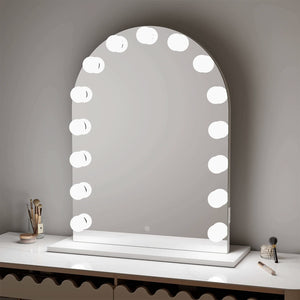
 Alicia Hollywood Mirror 60cmx80cm
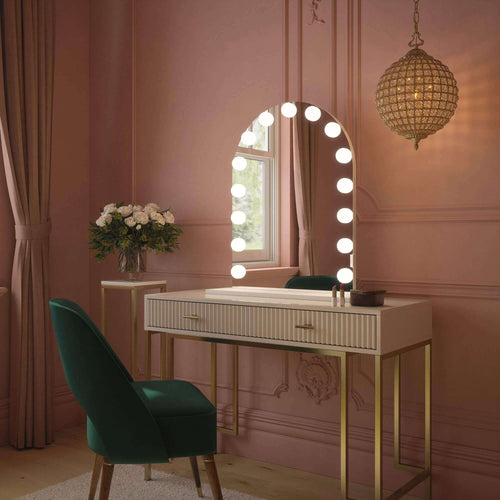
 Angelina Full Length Arch Hollywood Mirror 160 x 60cm
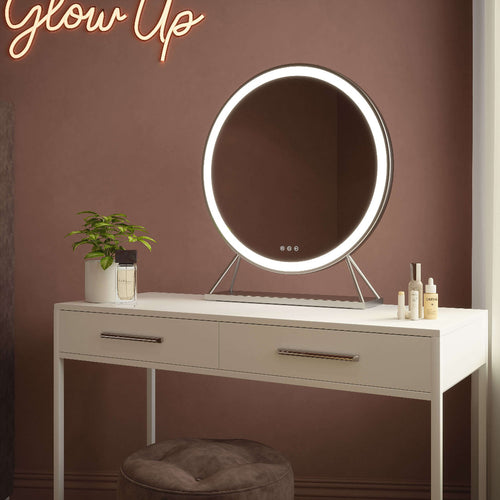
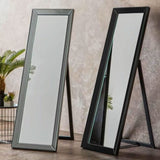 Angled Luna Mirror-Cheval Black
 Angled Luna Mirror-Cheval Silver