There's a particular moment of horror familiar to anyone who has upgraded to a proper magnifying mirror. You position yourself in good light, lean in for the first time at 5x or 10x magnification, and discover a landscape you barely recognise: pores like craters, fuzz you never knew you had, texture everywhere, and what appears to be an entirely new collection of marks and veins. It's enough to send anyone down a £200 skincare rabbit hole.
Here's the thing nobody tells you when you buy one: a magnifying mirror is a brilliant tool and a terrible judge. It shows you your skin at a distance and detail no human being will ever see you at. Used well, it makes precision jobs like tweezing, tightlining and blending far easier, and it can genuinely help you spot the small number of skin changes that deserve attention. Used badly, it convinces you that perfectly normal skin is a problem to be fixed.
So before you declare war on your own face, it's worth knowing which of the things you're seeing at high magnification are completely normal, and which few are actually worth acting on.
First, some perspective on magnification
At 10x magnification you are examining your skin more closely than a dermatologist typically does with the naked eye. Features that occupy a fraction of a millimetre in real life appear enormous. Nobody at a normal social distance, roughly arm's length and beyond, can resolve the details that dominate your view in a magnifying mirror. Even someone kissing you goodbye sees less than you're seeing.
That matters because skin was never designed to be smooth at that scale. Healthy skin has visible pores, fine hairs, subtle colour variation and texture. The airbrushed standard we compare ourselves to exists only in retouched photography and, ironically, in low-resolution glances at other people, whose skin we never inspect the way we inspect our own.
With that established, here's the honest breakdown.
Completely normal, however alarming it looks up close
Pores, including the ones that look enormous. Pore size is largely genetic and changes with age as skin loses some of its firmness. Under magnification, the pores across your nose, chin and inner cheeks will look dramatic. They are doing an essential job, releasing oil and regulating temperature, and they cannot be "closed," whatever the product marketing says. Keeping skin cleansed and exfoliated can make them appear tidier; nothing makes them disappear.
The little grey-ish dots in those pores. These are usually sebaceous filaments, natural structures that carry oil to the surface, not blackheads. Squeezing them achieves a day of satisfaction followed by their prompt return, plus irritation. At 10x they look like a problem. At normal distance they are invisible.
Peach fuzz. Fine vellus hair covers almost the entire face on every adult. Magnification makes it look like a pelt. It isn't visible to anyone else, and whether you remove it (dermaplaning has made this fashionable) is purely cosmetic preference, not necessity.
Fine lines in motion. Skin that creases when you smile, squint or raise your eyebrows is skin that's attached to working muscles. Expression lines viewed at high magnification, especially around the eyes, often prompt panic-buying in the anti-ageing aisle. Some softening of these is achievable with good skincare and sun protection, but their existence is not a flaw; it's a face.
A bit of redness or the odd visible capillary. Skin flushes with heat, exercise, wind, spice and wine. Transient redness that comes and goes with an obvious trigger is your circulation doing its job.
Worth keeping an eye on
A few things that show up clearly in a magnifying mirror sit in the middle category: not urgent, but worth monitoring rather than ignoring.
Clusters of thread veins. Individual broken capillaries are common and harmless, particularly around the nose. If you're noticing them multiplying across the cheeks, or persistent redness that no longer settles, that pattern can be an early sign of rosacea, which responds far better to early management than to years of being scrubbed at with harsh products. Gentle skincare and diligent SPF help; a GP or skin professional can advise if it's progressing.
Recurring breakouts in the same spots. The occasional hormonal spot before a period is textbook normal. Deep, persistent breakouts clustering along the jawline and chin month after month, especially arriving for the first time in your 30s or 40s, are usually hormonally driven and worth treating properly rather than covering, because adult acne is more likely than teenage acne to leave marks on skin that now repairs itself more slowly.
Worth actually doing something about
Pigmentation that's changing. Freckles and long-standing sun spots that look the same year after year are generally just a record of summers past. What deserves more attention is pigmentation that's deepening or spreading, new patches appearing across the cheeks, forehead or upper lip, or marks left by old breakouts that darken rather than fade. Patterns like melasma are notoriously stubborn, made worse by unprotected sun exposure, and respond far better to a professional assessment and a proper treatment plan than to trial-and-error with brightening products, many of which can aggravate the problem if used wrongly. Daily broad-spectrum SPF is the non-negotiable foundation either way; your magnifying mirror, used monthly rather than daily, is actually the perfect tool for noticing whether pigmentation is stable or shifting.
Anything new, changing or refusing to heal. This is the serious one, and the genuine superpower of owning a good mirror. A mole that changes in size, shape or colour, a new growth, a patch that itches or bleeds, or a spot that simply won't heal after several weeks should be seen promptly by your GP. The NHS guide to moles and when to seek advice sets out exactly what to look for. Caught early, skin cancers are highly treatable, and people who look at their skin closely and regularly are precisely the people who catch things early. That check is worth more than everything else your mirror does combined.
How to use a magnifying mirror without falling out with your face
A few habits make the difference between a useful tool and a daily confidence tax. Use magnification for tasks, not audits: brows, liner, precision jobs, then step back to a normal mirror to judge the overall effect, because the normal mirror is what the world sees. Check your skin properly about once a month in consistent, even lighting rather than scrutinising daily; skin fluctuates day to day with sleep, hormones, weather and salt intake, and daily inspection just documents noise. Even, shadow-free lighting matters more than magnification strength for judging skin honestly, since a single overhead bulb will invent shadows, redness and texture that daylight would never show. And if you find yourself picking at what you see, put the mirror somewhere less convenient; skin picked at 10x magnification heals at 1x speed.
The point of seeing your skin clearly was never to find more things wrong with it. It's to know it well enough to look after it properly, to notice the handful of changes that matter, and to leave the rest of it, the pores, the fuzz, the evidence of a face that moves and smiles, entirely alone.
Liquid error (sections/article-template line 192): Invalid form type "24\n", must be one of ["product", "storefront_password", "contact", "customer_login", "create_customer", "recover_customer_password", "reset_customer_password", "guest_login", "currency", "activate_customer_password", "customer_address", "new_comment", "customer", "localization", "cart"]





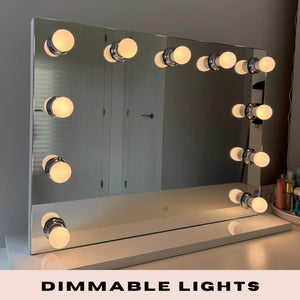
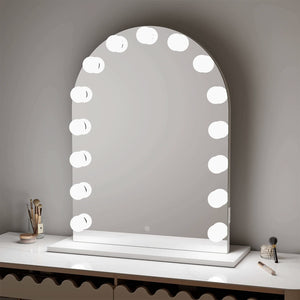
 Alicia Hollywood Mirror 60cmx80cm
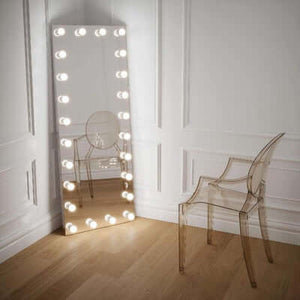
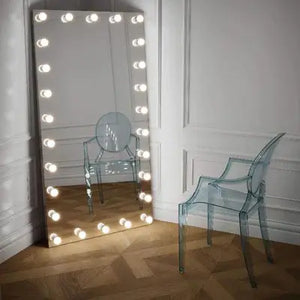
 Angelina Full Length Arch Hollywood Mirror 160 x 60cm
 Angled Luna Mirror-Cheval Black
 Angled Luna Mirror-Cheval Silver