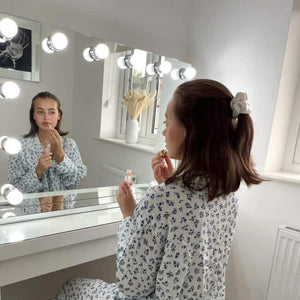
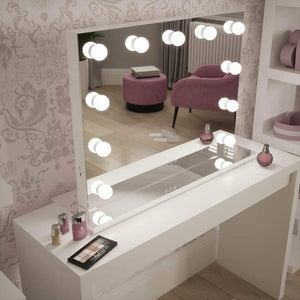
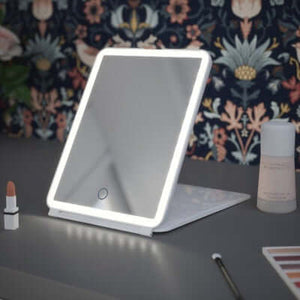
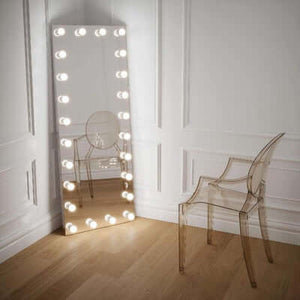
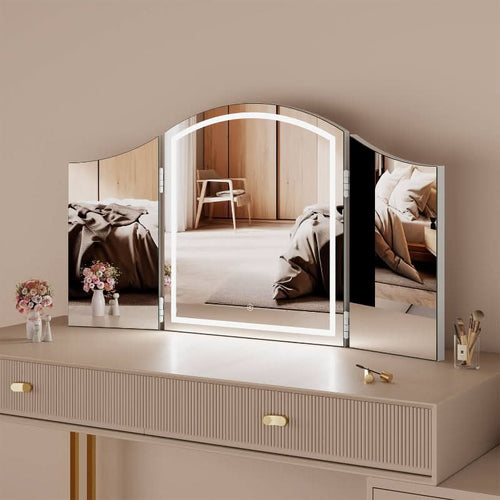
There is a particular kind of clutter that gathers around a dressing table: yesterday’s earrings, a palette left open, a hairbrush balanced across a jewellery dish. Add an illuminated mirror and several rows of bottles, and this small corner can become the most visually demanding part of a bedroom.
The answer begins with deciding what deserves to stay on show. A mirror earns its place through daily use. A favourite lamp can contribute something to the whole room. The rest needs to justify the space it occupies, especially on a table that is also visible from the bed.
A good arrangement should be easy to sit down at in the morning and pleasant to look towards in the evening. Those two requirements are a useful starting point for every choice that follows.
Begin With an Open Makeup Bag
Style the table while you are using it. An open makeup bag gives a more honest indication of the space you need than a closed one tucked neatly beside a vase. Set out the products you use most often, pull the stool into position and open the drawer you expect to reach.
This quickly exposes awkward furniture. A generous drawer may leave too little space for your thighs. A stool with a wide upholstered seat may catch on the legs. A shallow console might accommodate a mirror beautifully while offering nowhere to rest your forearms.
Resolve those difficulties before adding decorative pieces. Keep the area immediately in front of the mirror clear enough to work, with everyday products within reach. If the surface is small, a wall-mounted mirror can free up the space otherwise occupied by a stand, provided the wall and fixings are suitable.
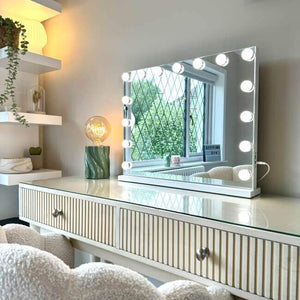
Position the mirror while seated on the actual stool or chair. You should be able to see your face without lifting your chin or leaning around the frame. Its relationship to your sitting position matters more than whether it is perfectly centred between the edges of the table.
Give the Mirror and the Lamp Different Jobs
Makeup lighting needs to help you see detail. Bedroom lighting also has to feel comfortable when there is nothing left to do. Trying to achieve both with a single decorative lamp often leads to compromises.
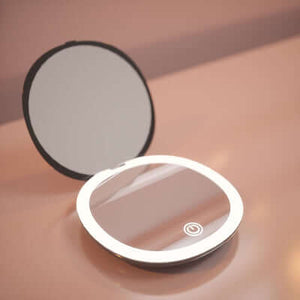
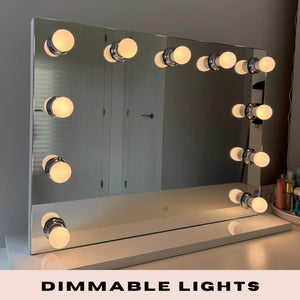
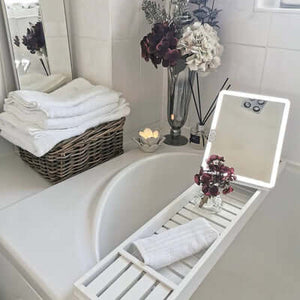
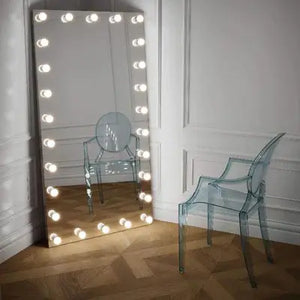
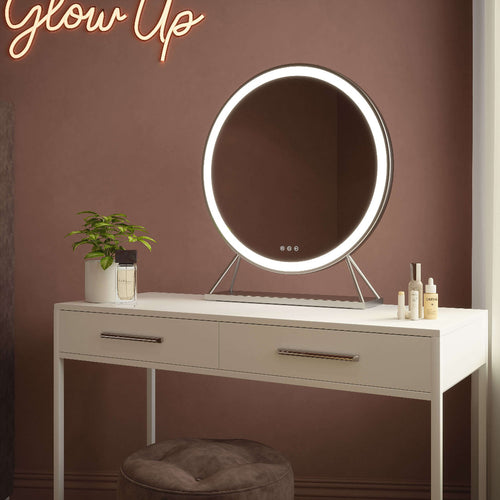
Check the light across your face rather than judging how bright the tabletop looks. An overhead fitting may illuminate the furniture while leaving shadows beneath your eyes. A strong light at one end can make the two sides of your face appear different. An illuminated mirror can bring light closer to the area you are using, although its position and brightness still need adjusting.
If the mirror has several settings, try them during your normal routine. Avoid choosing a setting simply because it is labelled “daylight” or appears brightest. Look for a comfortable view in which you can distinguish colour and blending without squinting into the lights.
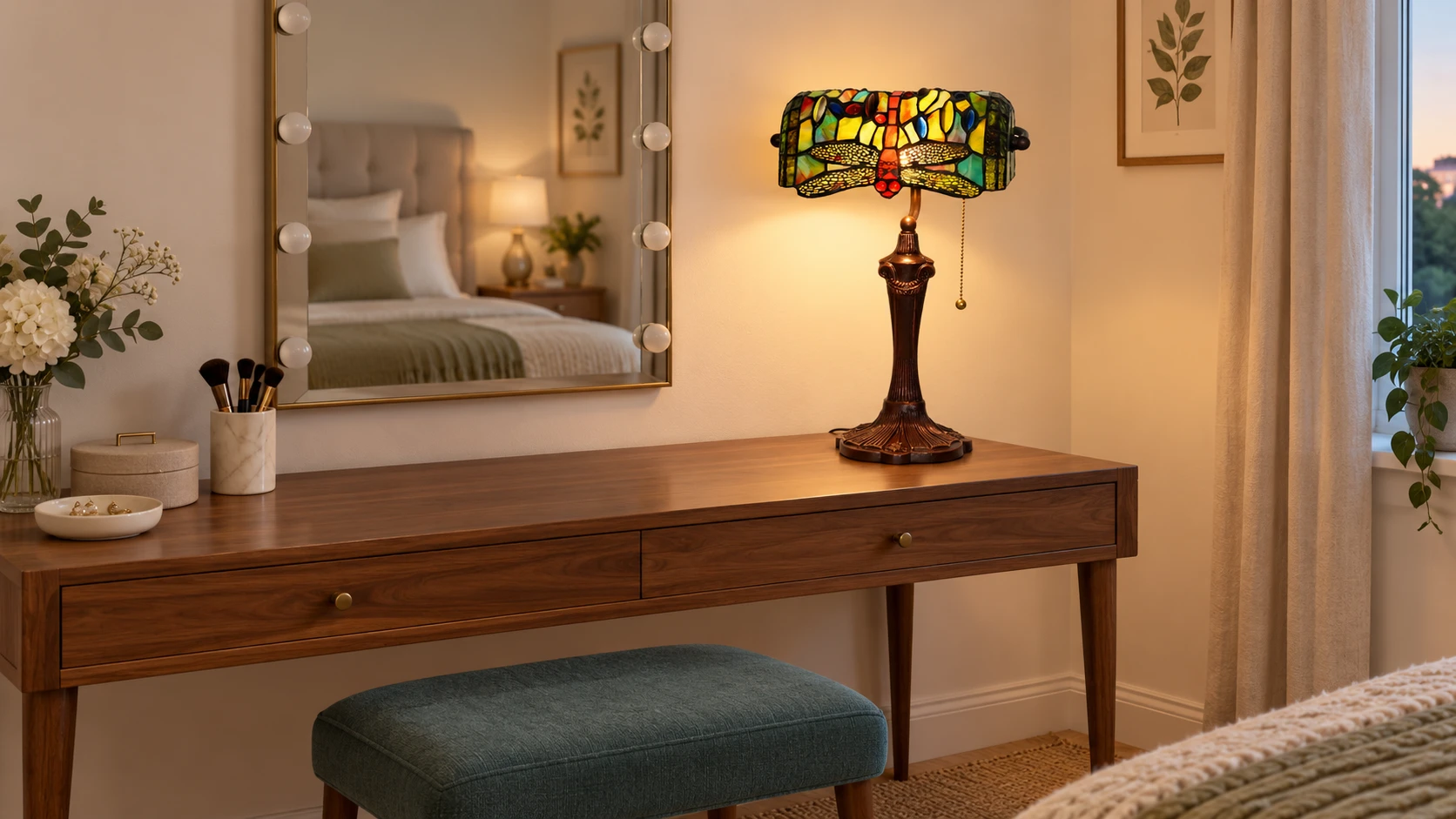
A stained-glass lamp belongs to the room’s evening arrangement. Its coloured shade adds interest when the mirror lights are off, but that filtered light should not be your reference when checking foundation or blusher. Keep the two sources independently controlled so that changing the atmosphere takes one simple action.
Let One Detailed Object Carry the Corner
A plain dressing table is a useful setting for an expressive lamp. The straight lines of the furniture give an intricate shade space to stand out, while the mirror connects the arrangement to the rest of the bedroom.
Compact Tiffany table lamps suit this approach because the glass supplies pattern, colour and a distinct outline within a single object. A dragonfly design, for example, can give a simple walnut table a recognisable character without needing several ornaments around it.
The shade is the important measurement. A lamp with a modest base may still occupy considerable space above the table. Check its width against the mirror and its depth against the furniture, allowing room for the shade to remain comfortably inside the table’s edge. Make sure your hand can reach the switch or pull chain without threading between bottles.
Choose the position with the lamp both lit and unlit. During the day, the base and glass pattern become part of the furniture arrangement. In the evening, the shade becomes more prominent. You need to enjoy both appearances.
For colour, pick a small detail from the glass and repeat it once nearby. Blue-green glass might connect with a muted teal stool; amber can sit naturally alongside warm wood. There is little benefit in reproducing every colour in cushions, containers and artwork. Leaving some colours confined to the shade helps preserve its appeal.
A restrained mirror frame is usually easier to combine with an ornate lamp. It also leaves more flexibility if you later change the bedding or wall colour. The frame and lamp base do not have to share exactly the same finish; compare their visual weight before worrying about matching metals.
Make the Storage Easy Enough to Use Every Day
A dressing table stays clear when putting things away is straightforward. Keep daily products together in an accessible drawer or a removable organiser. Store spare bottles and occasional makeup elsewhere, rather than allowing the tabletop to become a display of everything you own.
Leave out one small dish for jewellery if you actually use it. A low container is less likely to obstruct the mirror and easier to reach into than a tall decorative bowl. Likewise, a tray should have a practical purpose: containing a few items, protecting the surface or making cleaning quicker.
Think about cables before settling the furniture into place. The mirror and lamp leads should avoid drawer runners and the space occupied by the stool. Keep switches accessible, with enough slack to use them without pulling the equipment towards the edge.
The most revealing test comes at the end of a normal day. Can you clear the working area without moving the lamp? Does the drawer have room for the items that were left out? If tidying requires rearranging the whole display, remove something.
Look Back From the Bed
Once the table works from the seat, check it from where you rest. A mirror can reveal a crowded shelf or an exposed bulb that you barely notice while getting ready. Switch to the evening lighting and look at the reflection from your usual position on the bed.
A small adjustment to the lamp may remove an uncomfortable bright spot without disturbing the mirror’s useful position. Keep the shade outside the central area where you need to see your face, and check that it remains clear of curtains.
Then leave the arrangement alone for a few days. Notice what you keep moving, what you cannot reach and which objects end up in the way. Those observations are more useful than adding another accessory. The finished corner should accommodate an ordinary morning, then settle back into the bedroom with the makeup put away and the glass shade gently lit.
Liquid error (sections/article-template line 192): Invalid form type "68\n", must be one of ["product", "storefront_password", "contact", "customer_login", "create_customer", "recover_customer_password", "reset_customer_password", "guest_login", "currency", "activate_customer_password", "customer_address", "new_comment", "customer", "localization", "cart"]



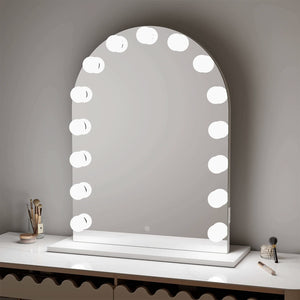
 Alicia Hollywood Mirror 60cmx80cm
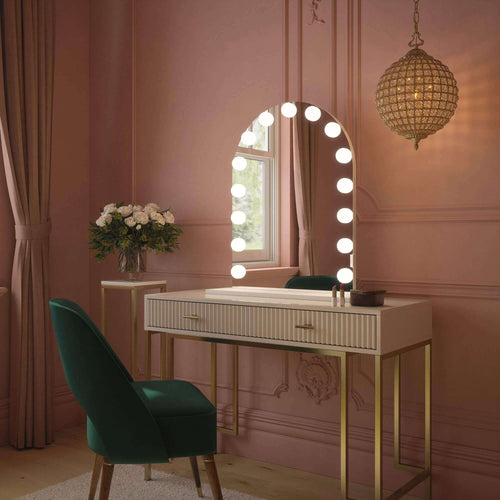
 Angelina Full Length Arch Hollywood Mirror 160 x 60cm
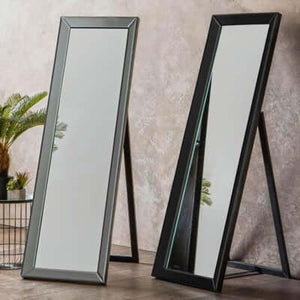
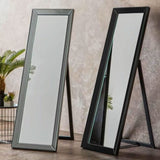 Angled Luna Mirror-Cheval Black
 Angled Luna Mirror-Cheval Silver